When I recently shared a post about my use of Mistral, I got the question: “Would love to hear more about your workflow setup. Curious whether you could possibly share a diagram.” That question deserves more than a diagram alone — so here is the complete workflow behind it.
The core in one sentence
I hardly write any code myself anymore. I set direction and own the process; an AI coding agent — Mistral Vibe, a CLI agent that works in my repository — does the execution and the first review. The workflow is not “run a prompt and hope for the best”, but a disciplined loop with fixed rules, a measurable backlog and a clear division of roles between me and the agent.
This is what the loop looks like:
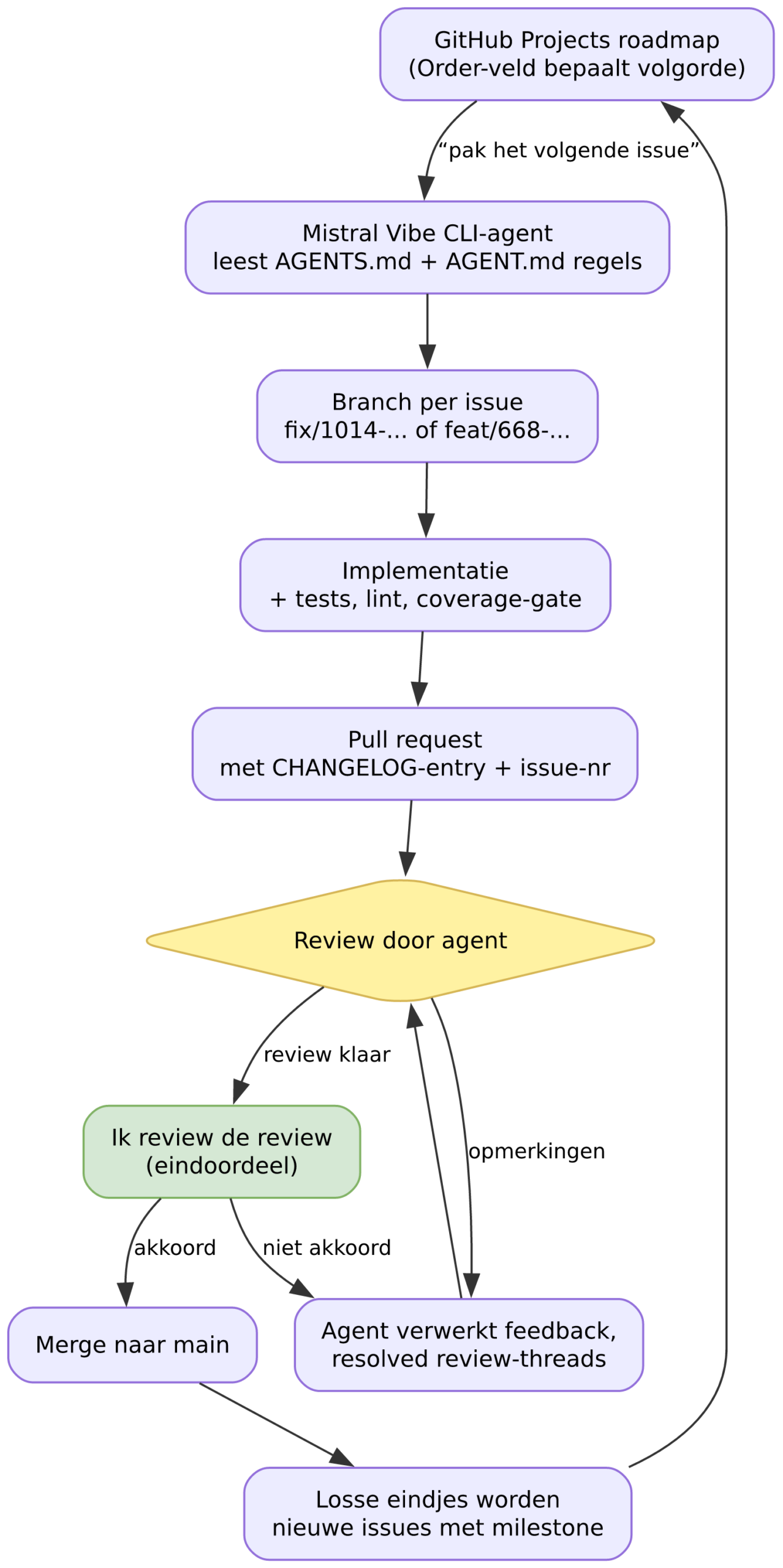
Below I walk through the components.
1. The roadmap is the queue, not me
Most frustration in agent-driven work comes from the question “what now?”. I automated that away: every issue in my GitHub Projects roadmap has an Order field. When I ask the agent to “pick the next issue”, it fetches the project board with gh project item-list, sorts by Order, and skips what is already done, in progress via an open PR, or a parent issue with sub-issues. What remains is hét next issue — no discussion, no decision fatigue.
It sounds like a small thing, but this may be the most important part. The agent only does meaningful work if the backlog is meaningful. My roadmap is therefore not a list I maintain, but the steering mechanism of the entire process.
2. Rules live in files, not in prompts
Explaining the same thing twice is once too many. All rules that apply to the agent live in instruction files that are loaded automatically in every session:
- User-level (
~/.vibe/AGENTS.md): personal preferences that apply everywhere, such as how “the next issue” is found. - Repo-level (
AGENTS.mdandAGENT.mdin the repository): project conventions — which test commands must run, how the changelog is maintained, how issues are labelled, which deprecation gate the suite must pass.
That means I do not have to start a session with “we work with Python 3.14, always run make check, don’t forget the changelog”. The agent knows that. Prompts therefore stay short: intent, not a manual.
3. One branch per issue, proof per PR
All work starts with a branch named after the issue (fix/1014-restic-multisource-restore, feat/668-file-volume-backup). The agent implements, runs the full test suite and linting, and opens a pull request with a changelog entry and the issue number.
Important detail: “the tests pass” is not a checkbox the agent fills in itself. The repo has a coverage gate of at least 80% and a deprecation gate that fails on repo-owned deprecations. The rules are hard and automated — the agent cannot “kindly interpret” them. When working with an agent, that is exactly what you want: objective criteria that apply outside the agent.
4. The agent reviews, I review the reviews
The first review is done by the agent itself — in a new session, with a fresh look at the diff, without the blind spots of whoever just wrote the code. The agent processes the comments: adjust, answer per review thread what changed, and resolve the thread. Nothing is left open.
But on top of that there is one more layer, and it is mine: I review the reviews. Does the diff read back as an answer to the issue’s question? Were the valid comments really addressed — and were the invalid ones substantiated aside rather than ignored? Was anything merged that I have not seen? That final check belongs to owning the process: the agent may review, the final judgement is mine. The agent never pushes or merges to the remote without me saying so — the agent steers, I decide.
5. Loose ends feed the loop
Every completed issue may yield new loose ends. Those do not disappear into a note, but immediately become new issues — with the same milestone as the original issue, so the work stays linked. That closes the loop: work generates next work, and everything returns to the board that determines the order in step 1.
So what is my role, actually?
The honest conclusion after working this way for a while: my role has shifted from writer to director. I spend my time on:
- Prioritising — what goes on the board and in what order.
- Setting rules — maintaining the instruction files, so quality does not depend on my prompt energy that day.
- Reviewing the reviews — the final check over what the agent assessed and what gets merged.
And the things I deliberately do myself: architecture decisions, security choices, and anything touching shared systems.
What you need yourself
Want to rebuild this? Here is the minimal set:
- A CLI agent that can work in your repository (shell, git, run tests) and reads instruction files automatically.
- A queue that sorts without you — a project board with an explicit ordering field.
- Hard, automated quality gates (tests, lint, coverage) that the agent cannot bypass.
- The discipline to immediately write back everything not yet done as an issue.
By the way, the biggest pitfall is not the technology, but the temptation to let the agent sign off its own review. Two AI layers wishing each other a smooth review is not a review — it is a rubber stamp in the net. The step in which I assess the reviews myself is precisely the step that guarantees quality. Without an owner on top, this is a pipeline that merges mistakes very quickly and very neatly.
Do you work with a coding agent too? I am curious how others stay owner of the review process — let me know in the comments.
#OpenSource #AI #SoftwareDevelopment #Mistral #DataEngineering #AgenticCoding